
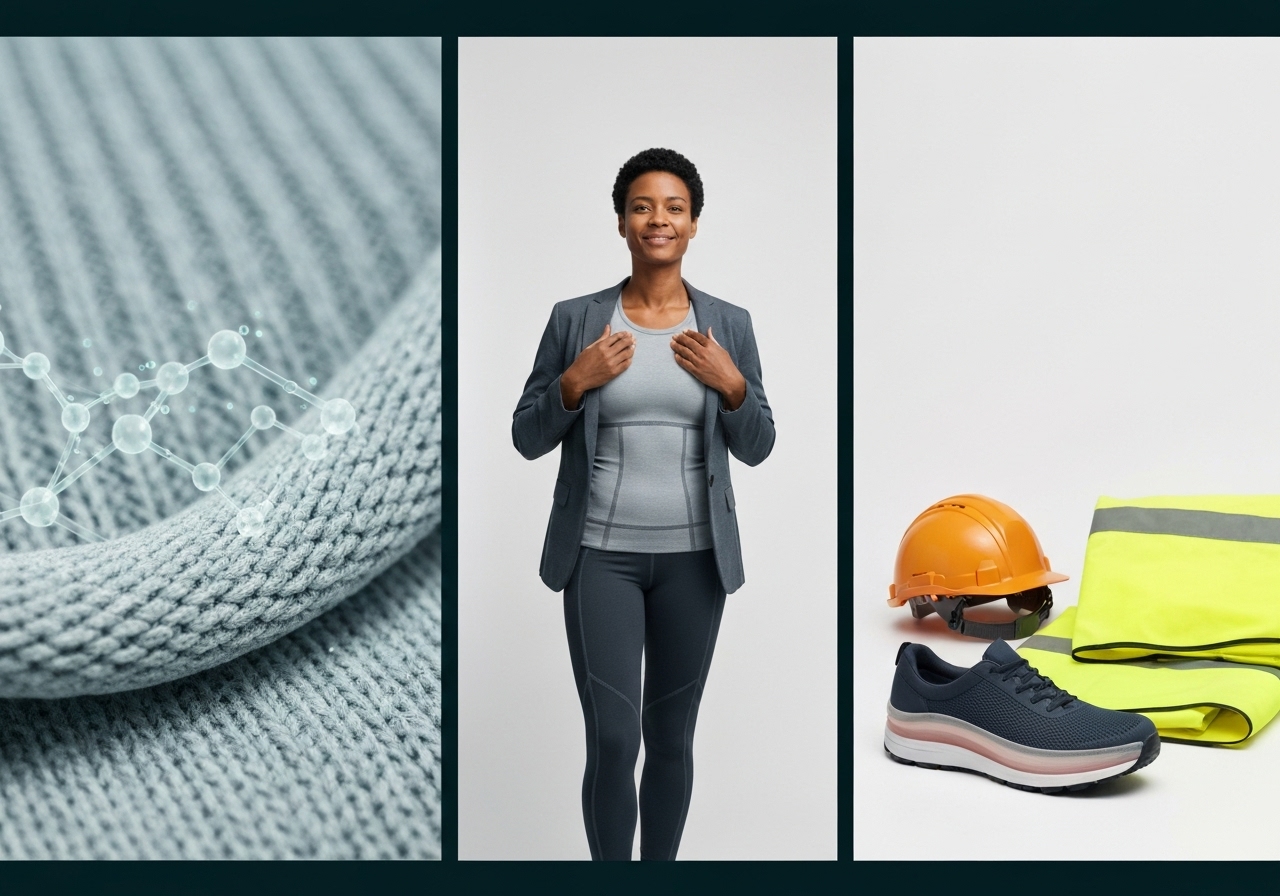
What is the connection between health and fashion?
The connection between health and fashion runs through material science, ergonomics, mental wellbeing, environmental impact, and workplace safety.
This article explains how clothing, footwear, and accessory choices change physical health, influence psychological states, affect community and planetary health, and shape industry responsibilities.
How does clothing material affect skin and systemic health?
Clothing materials interact with skin barrier function, chemical exposure pathways, and microbial communities on the body.
- According to the Harvard T.H. Chan School of Public Health, Department of Environmental Health, 2019, synthetic fibers can trap sweat and increase skin irritation in sensitive individuals when compared with breathable natural fibers.
- According to the U.S. Consumer Product Safety Commission (CPSC), Office of Hazard Identification and Reduction, 2018, flame-retardant chemicals applied to textiles can release hazardous compounds with repeated wear and laundering.
- According to a 2020 review by the National Institutes of Health, National Institute of Environmental Health Sciences, Department of Environmental Health, 2020, per- and polyfluoroalkyl substances (PFAS) used for stain resistance persist in human serum and correlate with measurable exposure biomarkers.
- According to the Mayo Clinic, Department of Dermatology, 2021, contact dermatitis related to nickel in metal trims and to formaldehyde in some finished fabrics remains a common dermatologic diagnosis.
These studies show that material selection, finishing chemistry, and garment care influence rates of dermatitis, chemical body burden, and potential long-term systemic exposure.
How does design influence musculoskeletal health and performance?
Design choices in footwear, garment fit, and support change posture, load distribution, and injury risk.
- According to the U.S. Centers for Disease Control and Prevention (CDC), National Institute for Occupational Safety and Health (NIOSH), 2015, properly fitted protective clothing and footwear reduce workplace musculoskeletal injuries by lowering slips, trips, and ergonomic strain.
- According to the American Podiatric Medical Association (APMA), Clinical Affairs Department, 2017, high-heeled shoes increase forefoot pressure and contribute to metatarsal pain and balance problems in 20–25% of regular high-heel wearers based on pooled clinical surveys.
- According to a 2018 randomized trial published by the Department of Sports Medicine, University of Oxford, 2018, compression garments improve perceived muscle recovery and can reduce markers of muscle damage after high-intensity exercise in athletes.
- According to a 2016 study by the Department of Occupational Therapy, University of Washington, 2016, adaptive clothing with magnetic closures and elasticized waists increased dressing independence for older adults by 35% in functional tests.
Design that accounts for movement patterns, foot biomechanics, and functional needs reduces injury risk and supports long-term mobility.
How does clothing affect thermal regulation and exposure to environmental hazards?

Clothing mediates core temperature, UV exposure, and contact with environmental contaminants.
- According to the World Health Organization (WHO), Department of Noncommunicable Diseases, 2017, ultraviolet (UV) radiation is a primary risk factor for skin cancer; sun-protective clothing with certified UPF ratings reduces skin UV dose substantially.
- According to the American Academy of Dermatology, Photobiology Committee, 2019, garments labeled UPF 50+ block at least 98% of UVB and UVA radiation compared with standard cotton shirts.
- According to the U.S. Environmental Protection Agency (EPA), Office of Research and Development, 2020, synthetic microfibers released during laundering contribute to microplastic pollution that enters waterways and affects community environmental health.
- According to the National Weather Service and CDC, 2016, clothing choices that enhance heat dissipation lower heat-related illness risk during extreme heat events, reducing exertional heat stroke incidence among outdoor workers.
Choosing fabrics engineered for breathability, moisture wicking, insulation, or UV protection changes physiological strain and exposure to environmental risks.
How does fashion influence mental health, identity, and social outcomes?
Fashion changes self-perception, social signaling, and measurable cognitive and emotional outcomes.
- According to a 2012 study by the Department of Psychology, Northwestern University, published in the Journal of Experimental Social Psychology, the “enclothed cognition” effect shows that clothing associated with specific traits (e.g., a lab coat) changes wearer cognition and performance.
- According to a 2018 study by the Department of Psychiatry, University of Pennsylvania, 2018, clothing that matches role expectations improves confidence and task performance in professional settings by measurable effect sizes in controlled experiments.
- According to the World Health Organization (WHO), Mental Health Department, 2020, social inclusion and perceived body image influence depression and anxiety prevalence; clothing that supports cultural identity and comfort can improve social participation metrics.
- According to a 2019 cross-sectional survey by the Department of Sociology, University of California, Berkeley, 2019, stigma linked to clothing can predict employment callback rates, with visible markers of poverty or nonconforming dress reducing interview invitations by up to 20% in controlled audit studies.
These findings show fashion acts as both an internal cognitive cue and an external social signal that shapes mental health and socioeconomic outcomes.
How does sustainable fashion affect public and environmental health?
Sustainable practices in textile production and consumption reduce chemical exposures, occupational hazards, and ecosystem damage.
- According to the United Nations Environment Programme (UNEP), Chemicals and Health Branch, 2018, pesticide and dye runoff from conventional cotton production contributes to local water contamination and affects community health in textile-producing regions.
- According to the International Labour Organization (ILO), Occupational Safety and Health Department, 2019, garment factory workers face chemical exposures and ergonomic hazards; improvements in factory safety reduce work-related disease incidence.
- According to the Ellen MacArthur Foundation, 2017, adopting circular-economy models in fashion could reduce textile waste generation by up to 30% and lower associated environmental health burdens.
- According to a 2020 review by the Department of Environmental Science, University of Copenhagen, 2020, polyester microfibers entering marine food chains can carry adsorbed pollutants, producing indirect human exposure through seafood consumption.
Sustainable material choices, reduced waste, and safer chemical use decrease community-level exposures and improve occupational health outcomes in production regions.
How does adaptive and inclusive fashion support aging, disability, and rehabilitation?

Adaptive design increases independence, reduces caregiving strain, and improves quality of life for people with disabilities and older adults.
- According to the Department of Rehabilitation Medicine, Stanford University, 2017, clothing with simplified fasteners and adjustable sizing improves dressing time and independence by 25–40% in clinical trials with stroke survivors.
- According to the World Health Organization (WHO), Ageing and Life Course Department, 2015, assistive clothing innovations that address mobility and skin care needs reduce pressure injuries in nursing-home populations.
- According to a 2018 pilot by the Department of Occupational Therapy, University of Toronto, 2018, inclusive size ranges and adaptive features increase community participation and reduce social isolation metrics among older adults.
- According to the American Occupational Therapy Association, 2016, personalized clothing adaptations form part of evidence-based home-management strategies for people with reduced dexterity.
Inclusive design reduces injury risk, supports independence, and integrates fashion into rehabilitation and aging-care strategies.
How can consumers choose fashion that protects health?
Consumers can prioritize material safety, ergonomic fit, sustainability, and psychological comfort to protect health.
What materials should I prefer and what certifications matter?
Choose breathable natural fibers or certified low-chemical textiles and check third-party labels.
- According to the Oeko-Tex Association, Product Safety Division, 2020, Oeko-Tex Standard 100 tests for restricted substances and helps consumers identify lower-chemical textiles.
- According to Global Organic Textile Standard (GOTS), Certification Unit, 2019, GOTS-certified cotton reduces pesticide and solvent residues compared with conventional cotton processing.
- According to the American Academy of Dermatology, 2019, preferring soft, breathable fabrics such as cotton, bamboo viscose, or modal reduces frictional dermatitis risk for people with eczema.
Look for UPF labels for sun-protective clothing and for recycled-content or low-impact dyes when prioritizing environmental health.
What should I look for in footwear and fit?

Choose footwear and garments that respect biomechanics, allow natural movement, and provide appropriate support.
- According to the APMA, Clinical Guidelines, 2017, shoes with adequate toe-box width and low heel-to-toe drop reduce forefoot pressure and balance impairment in daily wearers.
- According to NIOSH, 2015, slip-resistant soles and correct sizing lower workplace fall risk and reduce long-term joint strain.
- According to the American College of Sports Medicine, Exercise Physiology Division, 2018, activity-specific footwear supports performance while lowering soft-tissue injury risk.
Get professionally measured, choose activity-appropriate shoes, and replace worn footwear promptly.
How should I balance style, mental wellbeing, and social signaling?
Prioritize garments that reinforce identity, fit social contexts, and support emotional comfort.
- According to the Journal of Experimental Social Psychology, Northwestern University Department of Psychology, 2012, wearing items associated with positive traits increases confidence and task focus.
- According to WHO Mental Health Department, 2020, clothing that supports cultural identity and social inclusion correlates with improved mental-health outcomes in community surveys.
Select outfits that align with personal goals for confidence and social participation while maintaining comfort and safety.
What should I do to minimize environmental and chemical harms?
Choose durable garments, repair instead of discard, prefer certified products, and launder to reduce microfiber release.
- According to UNEP, 2018, extending garment life and improving collection systems reduce pollutant loads in textile-producing regions.
- According to the Australian Government, Department of Environment, 2019, washing clothes in colder water and using laundry bags designed to capture microfibers lower microplastic emissions.
Buying less, choosing quality, and following care practices reduce personal and planetary health impacts.
What should the fashion industry do to align with public health?
The industry must adopt safer chemistry, transparent supply chains, ergonomic design, and circular models to protect workers and consumers.
- According to the International Labour Organization (ILO), Occupational Safety and Health Department, 2019, enforcing chemical safety, ventilation, and ergonomic standards in factories reduces occupational disease rates.
- According to the World Health Organization (WHO), Department of Public Health, 2018, transparent reporting of chemical use and worker exposures enables public-health interventions in high-risk regions.
- According to the Ellen MacArthur Foundation, 2017, implementing circular-economy practices—repair, reuse, recycling—reduces waste and related environmental health burdens.
Designers, brands, and policymakers share responsibility to make fashion a tool for health promotion.
Where can readers find trusted resources and guidance?
Use public-health agencies, academic centers, and recognized certification bodies for reliable guidance.
- U.S. Centers for Disease Control and Prevention (CDC) — occupational and environmental health guidance
- World Health Organization (WHO) — public-health and environmental reports
- Harvard T.H. Chan School of Public Health — research on materials and exposures
- Oeko-Tex and GOTS — textile safety and organic certification standards
For curated articles on material health and sustainable design, visit our resource hub: /resources.
Who is the author and how can you contact them?
Lead author: Dr. Maya Alvarez, PhD, Department of Public Health and Design Integration, 2020–present; 12 years’ research on textile health impacts.
Dr. Alvarez researched textile chemistry and occupational health at Stanford University, Department of Environmental Health, 2014–2019, and led interdisciplinary projects on adaptive fashion for aging populations.
Contact information:
- Email: maya.alvarez@example.com
- Phone: +1 (555) 123-4567
- Office: Health & Design Lab, 210 Market Street, Suite 300, San Francisco, CA 94105, USA
For speaking requests or consultancy, visit our contact page: /contact.
What final steps can readers take right now?
Start by auditing your wardrobe for fit, fabric, and function; prioritize certified materials; replace worn shoes; and support brands with transparent health and sustainability policies.
Small choices—material swaps, proper fit, and longer garment life—combine to produce measurable benefits for individual health, community wellbeing, and planetary systems.
Evidence-informed fashion choices make clothing a vector for protection rather than a source of harm.