
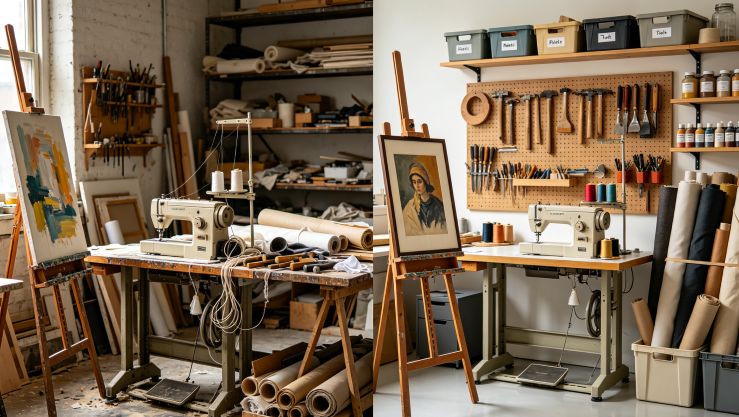
The World Health Organization recognizes that environmental conditions influence health and well-being, while studies from Princeton University Neuroscience Institute have found that excessive visual clutter can reduce the brain’s ability to focus on tasks. These findings help explain why many artists, designers, and makers periodically reorganize their workspaces or seek professional assistance with property clearance. Whether clearing a home studio, shared workshop, or creative office, property clearance services in Vienna (büroentrümpelung Wien) are often considered when spaces become difficult to manage after years of accumulated equipment, materials, and furniture.
Creative Spaces Reflect Different Working Styles
Creative work rarely follows a single pattern. Some artists thrive in busy environments surrounded by reference materials, unfinished projects, and collections of tools. Others perform best in carefully organized spaces where every item has a designated place. Both approaches have strengths, yet every creative environment eventually reaches a point where accumulated belongings begin to interfere with productivity rather than support it.
This contrast creates an ongoing discussion within creative industries. A workspace filled with sketches, fabric samples, paints, cameras, wood, or sewing equipment may inspire new ideas. At the same time, excessive accumulation can reduce usable space, increase cleaning requirements, and make it harder to locate essential supplies.
Professional property clearance offers a structured way to separate valuable materials from unnecessary clutter without assuming that every stored item has lost its purpose.
Cluttered Versus Organized Creative Environments
A cluttered studio often develops gradually. New projects bring additional materials, while completed work leaves behind packaging, broken equipment, unused furniture, and outdated storage systems. Because creative professionals frequently reuse supplies, items that appear unnecessary may remain untouched for years.
Research published by the Princeton University Neuroscience Institute indicates that multiple competing visual stimuli can limit a person’s ability to concentrate. While creative work certainly benefits from inspiration and experimentation, excessive visual distractions may slow decision-making and reduce efficiency during detailed tasks.
An organized creative space presents a different experience. Essential tools remain accessible, storage areas become easier to maintain, and projects move more smoothly from planning to completion. Organization does not require minimalism. Instead, it focuses on making the environment functional while preserving materials that continue to serve a practical purpose.
The Debate Around Keeping Creative Materials
Many creative professionals hesitate to dispose of old materials because they believe every object could inspire a future project. This concern is understandable. Fabric remnants, reclaimed wood, vintage frames, unused canvases, or decorative hardware often become valuable resources later.
However, keeping everything creates its own challenges. Materials stored without labels or proper organization may deteriorate through moisture, dust, or accidental damage before they can be reused.
A balanced approach emphasizes evaluation instead of automatic disposal. Reusable materials can be sorted, cleaned, and stored properly. Damaged or unusable items can enter appropriate recycling or waste management systems. Objects with artistic or educational value may even be donated to schools, community workshops, nonprofit organizations, or local art programs where they continue serving useful purposes.
Property Clearance Beyond Residential Homes
Property clearance is commonly associated with moving house or managing inherited properties, yet creative environments present different requirements. Studios and workshops often contain specialized equipment, large worktables, shelving units, lighting systems, paints, textiles, electronic devices, and construction materials.
These items require careful sorting because disposal rules differ depending on the material. Electronics may qualify as electronic waste, while chemicals, solvents, batteries, and certain paints require specialized handling.
Data from the European Environment Agency shows that improving waste separation increases opportunities for recycling and material recovery while reducing environmental impacts. Careful sorting during creative workspace clearances supports these broader sustainability objectives.
Health and Indoor Cleanliness
Workspace organization influences more than productivity. Indoor cleanliness directly affects comfort and long-term maintenance.
Dust commonly collects beneath shelving, behind storage cabinets, and inside overcrowded work areas. Textile studios generate fabric fibers, woodworking shops produce sawdust, and ceramics workshops accumulate fine clay particles. When spaces remain overcrowded, routine cleaning becomes increasingly difficult.
The United States Environmental Protection Agency (EPA) explains that good housekeeping practices help reduce indoor pollutants and improve overall indoor environmental quality. Although clutter alone does not automatically create unhealthy conditions, excessive accumulation often makes regular cleaning less effective. The importance of maintaining clean, well-maintained creative environments extends beyond appearance, helping studios and workshops remain functional while supporting healthier conditions for artistic and design work.
After unnecessary items are removed, floors, ventilation systems, storage areas, and work surfaces become easier to maintain. This supports a cleaner environment for artists, designers, employees, clients, and family members using shared creative spaces.
Preserving What Still Has Value
Property clearance should not be viewed as removing everything from a workspace. A thoughtful process focuses on identifying what deserves preservation.
- Reusable art supplies can remain available for future projects.
- Functional furniture may be relocated within the workspace.
- Vintage equipment with historical or creative value can be preserved.
- Unused materials suitable for education or community projects may be donated.
- Damaged items can be recycled whenever appropriate facilities exist.
This approach reduces unnecessary waste while supporting responsible resource management.
Supporting Creative Efficiency Without Limiting Creativity
Creative professionals often worry that too much organization may reduce spontaneity. Yet organization and creativity do not have to compete.
An efficient workspace still allows experimentation while making everyday tasks easier. Clear walkways improve safety, labeled storage saves time, and dedicated work areas help separate ongoing projects from completed ones. Designers can focus on developing new collections, artists can concentrate on producing work, and hobbyists can enjoy their studios without constantly searching for misplaced supplies.
The discussion therefore shifts away from choosing between clutter and perfection. Instead, it becomes a question of maintaining a workspace that supports creative thinking without allowing accumulated belongings to become obstacles.
Conclusion
Creative environments naturally evolve as projects, materials, and equipment accumulate over time. Some degree of organized complexity may inspire artistic work, while excessive clutter can reduce efficiency, complicate cleaning, and limit available workspace. Comparing these two approaches highlights that successful studios are rarely defined by how much they contain, but by how effectively they function.
Professional property clearance contributes by helping owners evaluate possessions carefully, preserve reusable materials, donate valuable supplies, and dispose of waste responsibly. Combined with thoughtful organization and regular maintenance, these practices create healthier studios, workshops, and home creative spaces that remain practical without sacrificing the flexibility that creative work often requires.